Four years on a browser softphone
What it is
Compass Bridge is a softphone that runs in a browser tab. Real phone calls from a web page — place them, receive them, transfer them, join and leave queues, see who's free before you transfer. It sits on a cloud PBX and consumes a live stream of call events over XMPP. Deployed across seven reseller brands.
I was the sole front-end developer on it for four years — around 520 commits, second only to the engineer who started it, out of twelve-plus contributors. Four things stood out from those four years.
1. Calls
Before 2022, Bridge showed you your calls but couldn't make them — you needed a desk phone next to it. The work was to turn the browser tab itself into a phone, so a Bridge user needed nothing but a computer.
The backend was built by the platform team. Mine was the client: SIP registration over WebRTC, audio device enumeration and selection, the microphone permission flow, and multi-call state — because a phone that can only hold one call isn't a phone. Hold, consult, transfer, and a second incoming call while you're already talking all have to be representable at once.
That state machine ended up as the single densest thing I owned in the app, and the reason is unglamorous: a phone has more states than it looks like it has, and users notice all of them. A button that says "transfer" has to know whether the other side has answered yet, because attended and unattended transfer are different operations with different failure modes.
Some of the hardest bugs were not in the call logic at all. Notifications and ringtones
failed to fire if the user had the Settings page open when a call arrived — reported from
production, medium impact, and exactly the kind of defect that only shows up in a real
workday. Others were platform-specific: notifications behaving differently on Windows 11,
a console.log that broke under Electron, code-signing on macOS.
The desktop builds were eventually retired: around 99% of users had already moved to the browser version. Some of the fiddliest work in this project was maintenance on something the product later dropped.
2. Call history
Bridge showed your current calls. It had no history — step away from your desk, come back, and you had no idea who had tried to reach you.
Add call history to a softphone. Sounds like a list view. It took two architectural rewrites and about twenty-five distinct call scenarios, because "did I miss this call?" turns out not to be a question the telephony platform answers directly.
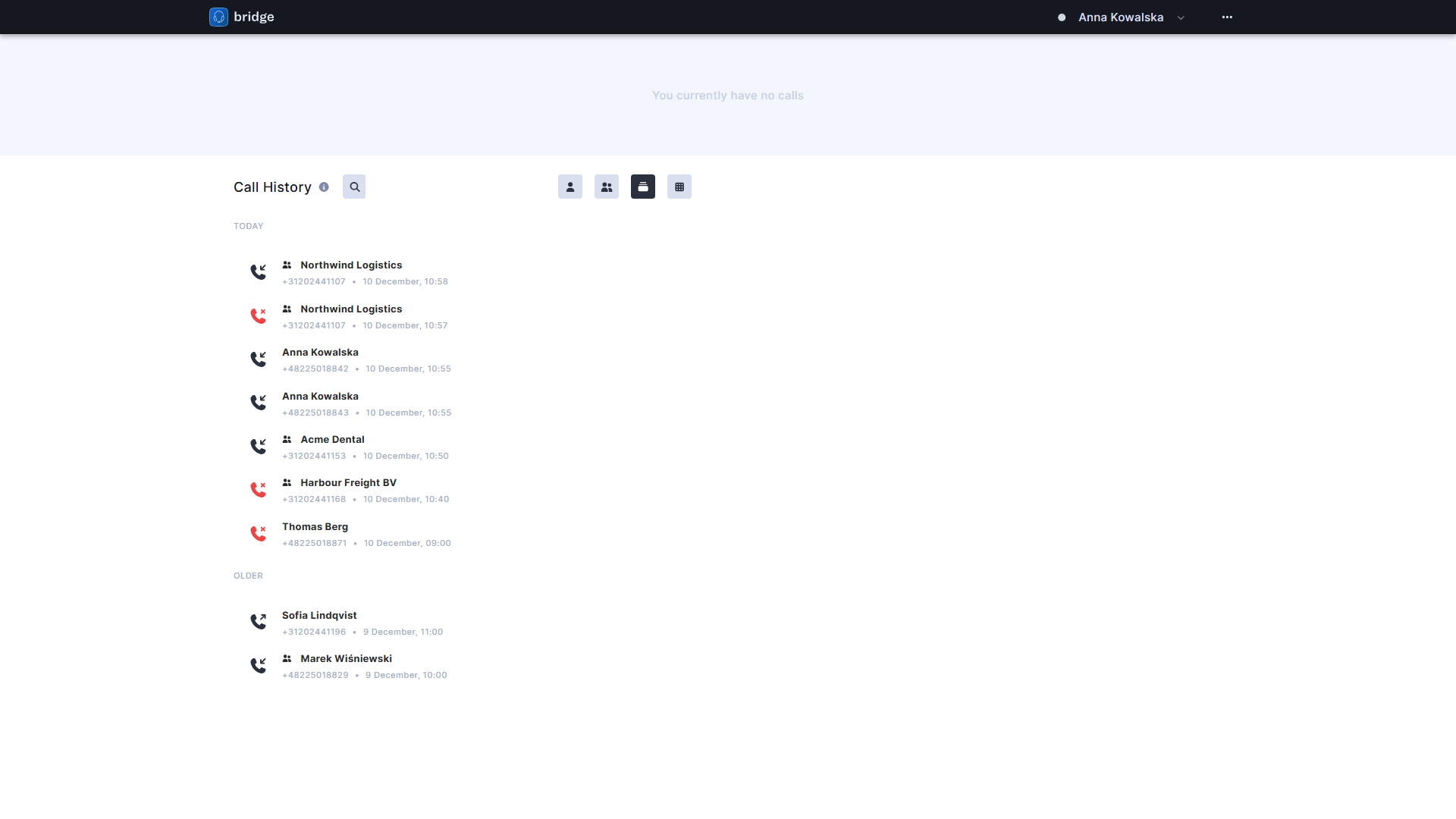
"Missed call" is not a boolean
The requirement was two sentences: "a missed call is a call that you missed. Cancelling an incoming call is not a missed call." Then QA and one of the maintainers started asking questions, and a decision tree appeared underneath it.
A queue re-offers a waiting call to its agents every 15–25 seconds, so one caller waiting two minutes naively produces five missed calls per agent — they have to collapse into one. Except with the "call available phones alternatively" strategy, each round genuinely is a separate miss. If four agents' phones ring and one answers, the other three missed it — but that needs its own end reason, not the same one as a caller who hung up. An agent in wrap-up is never offered the call, so no miss; an agent with call waiting who is already talking gets a genuine second call, so yes.
We settled the forwarding question empirically rather than by opinion: I tested what physical desk phones do. On busy, no-answer and unavailable, both Snom and Yealink register a missed call — so Bridge does. On always, neither handset registers anything, so Bridge doesn't either. That principle — match the physical phone, because users have one on their desk — resolved several later arguments.
One case we couldn't fix. Snom and Yealink handle semi-attended transfer differently at the PBX level, so the events Bridge receives genuinely differ by vendor. After several attempts we documented it as a known issue rather than shipping a fragile guess.
Listening instead of inferring
The design settled on listening for the platform's own end reason rather than reconstructing it after the fact. The PBX emits an end reason with every call-end event, and the middleware surfaces it as it arrives:
// compassDataMiddleware.ts — surface the end reason as it arrives.
callEndEvents$: Subject<CallEndEvent> = new Subject()
That keeps correctness tied to the platform's own signal rather than to inference, and it's simpler: no bookkeeping to reconstruct which queue re-offer cycles belong to the same logical call, because the platform already says so.
The remaining piece is CallMetadata: per-call state accumulated while the call is
live, because a history entry depends on things only observable during it — was it ever
offered to me, which queue did it arrive through, is this the consultation leg of a
transfer, how long did it ring. Ring time isn't in any event — it's the interval between
"presented" and "answered or ended", so tracking starts when the call appears and stops
the moment it's answered.
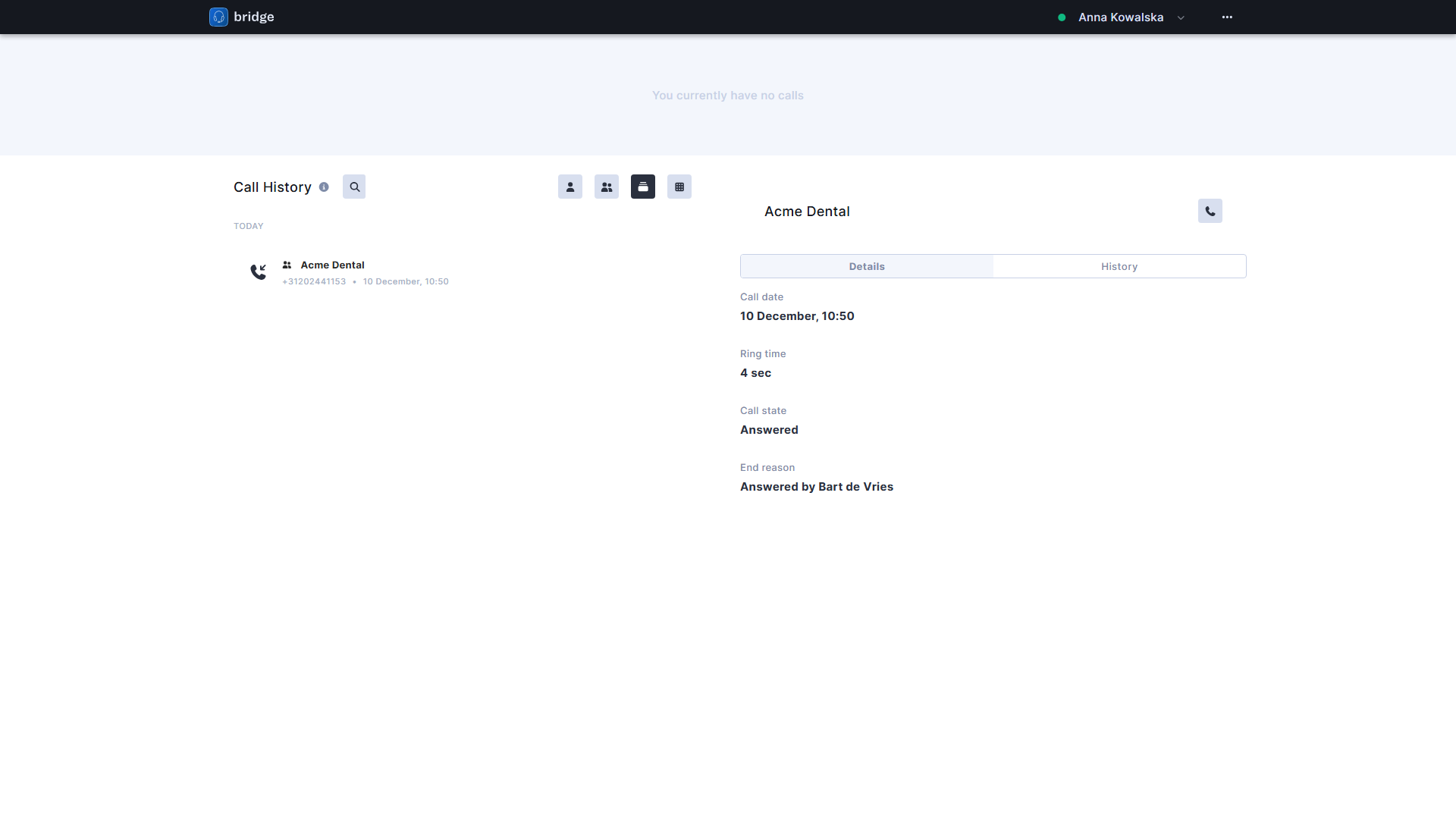
History is stored per user in localStorage, following the app's existing convention.
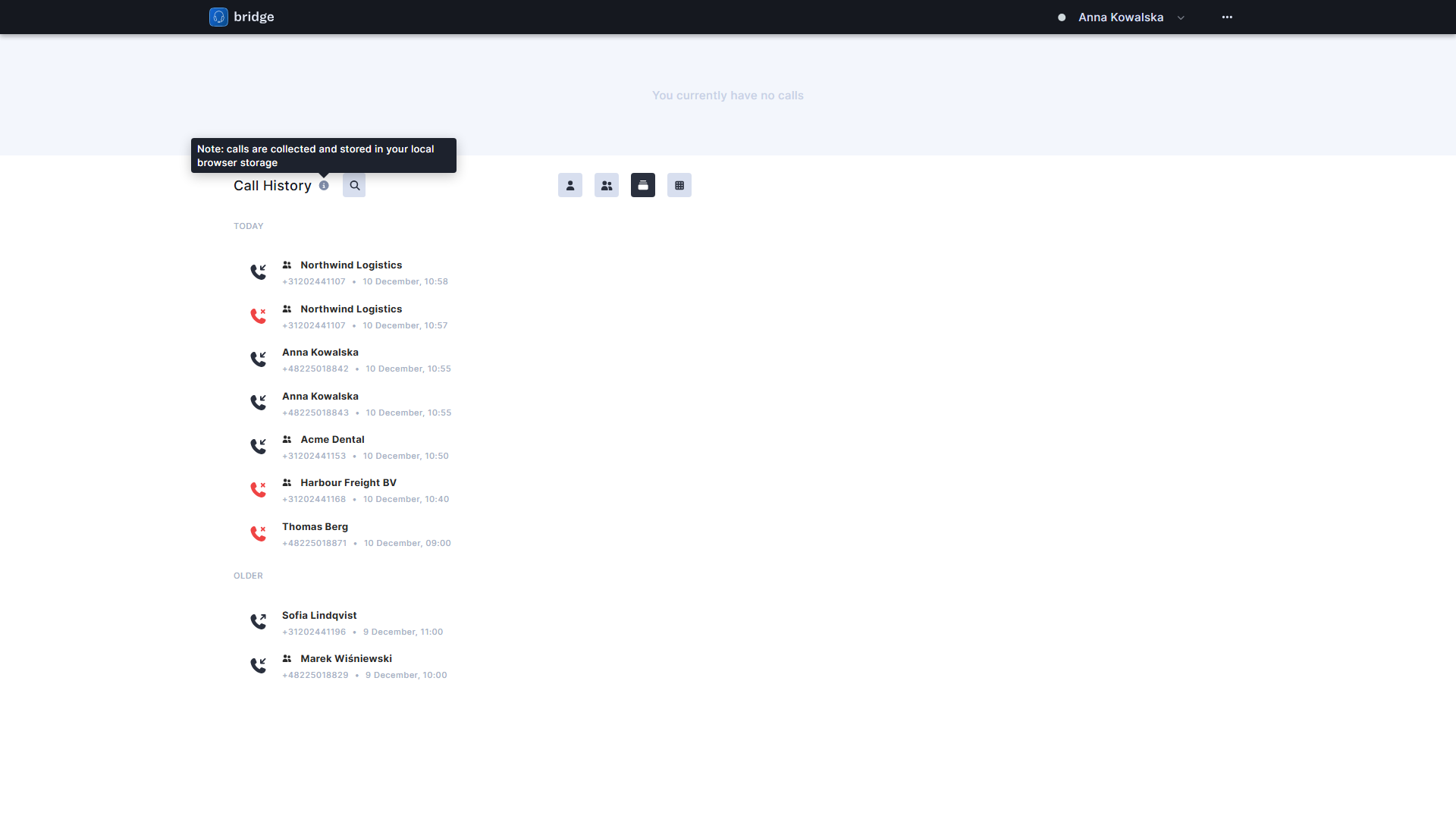
The product decision was to accept the consequences and be honest in the UI rather than
build a backend — only the logged-in user sees their own history, and a tooltip says
plainly where the data lives. It doesn't follow you between devices. The entry cap moved
from 100 to 2000, which raised the question of how the browser renders that many rows —
it doesn't, not naively, so I added virtualisation, reusing the implementation already
proven on the contacts list.
3. Refactoring
The codebase predated most of what it now uses: class components with Redux connect,
SASS, TSLint, Webpack, Node 12 in CI. The modernisation plan arrived as a nine-item list
from one of the platform's architects in December 2022 — upgrade dependencies, convert to
functional components, Redux Toolkit and RTK Query, Tailwind, fix the Mac CI build, drop
the dead API v2 path. My job was to execute it.
There was never a version where the app stopped. Bridge isn't a dashboard — it's what's on someone's screen while a customer is on the line, so a regression means a missed call. Everything had to land incrementally, in an app still shipping features, in diffs a reviewer could actually read.
Where it ended up: React 19, Vite, ESLint 9, typed Redux, Prettier enforced in CI.
A few decisions carried through the whole migration rather than being one-off fixes.
Converting connect class components to hooks meant moving selectors to useSelector
throughout, memoised with createSelector so the derived objects stay referentially
stable — worth being deliberate about in an app that re-renders on a continuous XMPP
event stream, where call state, presence, queue membership and chat are all arriving
and dispatching constantly. Icon imports stayed scoped to what a component actually
uses rather than pulled from a barrel file, since importing the whole set defeats
tree-shaking and inflates the bundle. And landing the migration itself meant keeping
each merge request to one concern — a Redux/RTK Query pass in one MR, a build-tool
change in another, a new feature in its own — so a reviewer is looking at one kind of
change at a time rather than several at once.
A comment I pushed back on
Part of taking review seriously is knowing which comments are wrong. Asked why a timeout
was declared with let and assigned later, the answer was that timeout and unsubscribe
reference each other — the setTimeout callback calls unsubscribe(), the subscribe
callback calls clearTimeout(timeout). One has to be declared before it can be assigned.
The eslint-disable was load-bearing, and the code stayed.
4. Cypress tests
Bridge had no visual regression testing before I added it. I built the Cypress e2e suites for the critical paths and introduced visual regression testing with image snapshots, plus a CI job for regenerating them so a legitimate UI change doesn't require a developer to run the suite locally and commit binaries by hand.
That last part matters more than it sounds. Snapshot testing that's painful to update gets deleted.
Tests shipped alongside the call-history feature rather than as a follow-up ticket, because a deferred test ticket tends to lose priority, and the feature went through enough subsequent refactoring that the tests paid for themselves within a week.
Fixtures use absolute timestamps rather than values relative to now, with time frozen
via cy.clock, so a result doesn't depend on the date the suite happens to run.